Mediet4All Memory Game Report
Within the framework of the Mediet4All project, Microtarians SIS designed an educational memory game inspired by the project’s objectives, Mediterranean recipes, and the benefits of the Mediterranean diet.
The main objective of the game is to promote:
Nutritional knowledge
Cognitive skills
Social interaction
Through playful learning, the game combines classic memory mechanics with Mediet4All recipes, healthy Mediterranean ingredients, and special “Super ingredient” cards that introduce strategy and adaptability.

1. How to Play the Mediet4All Memory Game
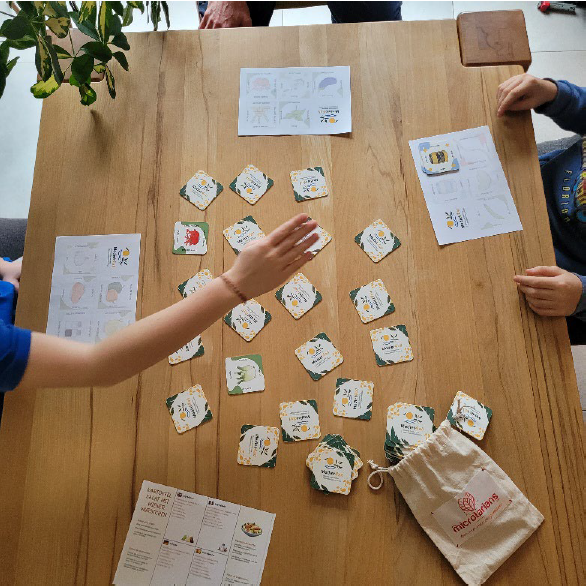
The Mediet4All memory game can be played by 1 to 6 players and lasts between 10 and 60 minutes, depending on the chosen difficulty level and number of participants.
Game Setup
At the beginning of the game:
Each player receives one or more Mediterranean recipe cards.
The number of recipes depends on the selected difficulty level.
Each recipe includes five specific ingredients that players must collect.
Ingredient cards are shuffled and placed face down on the table.
Players must find matching ingredient pairs to complete their assigned recipe(s).
The Role of “Super Ingredient” Cards
The game also includes special “Super ingredient” cards, identifiable by yellow stars.
When a player finds a matching pair of Super ingredients, a special effect is immediately activated. These effects may include:
Looking at a hidden card
Swapping recipes
Stealing or reshuffling ingredient pairs
Skipping an opponent’s turn
Exchanging card positions
These strategic elements increase engagement, introduce adaptability, and maintain dynamic gameplay.
End of the Game
The game ends when a player successfully completes all ingredient pairs required for their recipe(s).
2. Player Feedback and Testing Results
Feedback collected during six testing phases was overall very positive.
Players particularly appreciated the original combination of memory gameplay and Mediterranean food education. As a result, learning became both enjoyable and meaningful.
Adaptability to All Ages and Skill Levels
One of the key strengths identified is the game’s adaptability. Thanks to its three difficulty levels, it can easily be adjusted:
For younger players or beginners: A single recipe ensures quick understanding and reduced cognitive load.
For adolescents and adults: Multiple recipes increase complexity, memory demand, and strategic thinking.
This flexibility makes the game suitable for diverse learning environments
Engagement Through Super Ingredient Cards
Players highlighted the Super ingredient cards as a motivating and entertaining feature. These cards:
Introduce surprise and interaction
Create dynamic changes in gameplay
Prevent repetitive play
Maintain attention during longer sessions
As a result, the game remains engaging even over extended periods.
Cognitive and Educational Benefits
Educators emphasized that the game contributes to the development of key cognitive skills, including:
Strengthening memory, attention, and concentration through visual matching and recall
Developing strategic thinking and decision-making
Reinforcing knowledge through repetition
Furthermore, the repetition of recipes and ingredients supports long-term learning about healthy dietary habits.
Promoting Mediterranean Diet and Health Education
Beyond cognitive development, the game actively supports nutritional and health education objectives.
Through familiarization with Mediterranean diet ingredients and recipes, the game fosters:
A positive association with healthy eating
Awareness of Mediterranean food culture
A playful and non-prescriptive learning approach
Consequently, players internalize healthy habits in a natural and engaging way.
Intergenerational and Multicultural Learning
Thanks to its multiplayer format and multilingual availability (four languages), the game encourages:
Intergenerational learning
Multicultural exchange
Inclusive participation
Children, adults, and older adults can play together, making the game suitable for both formal education settings and non-formal learning environments.
Some players also noted its accessibility for diverse age groups and learning abilities, reinforcing its educational value across different contexts.