
Multinational e-Survey Publication Synthesis & Dissemination Package
The MEDIET4ALL survey reveals how Mediterranean lifestyle habits vary across 10 countries.
From Diet to Daily Life: What 4,010 Participants Across 10 Countries Taught Us About the Mediterranean Lifestyle
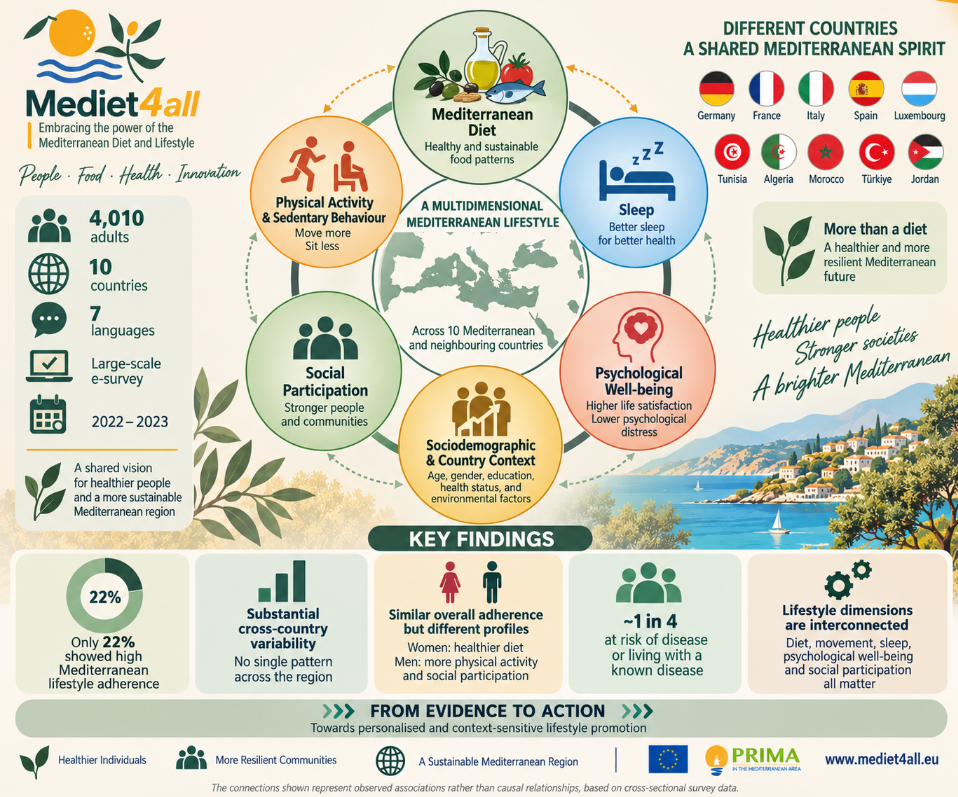
The MEDIET4ALL multinational survey publication series brings together evidence on how diet, movement, sleep, psychological well-being, social participation and context intersect across Mediterranean and neighbouring countries.
What does living a Mediterranean lifestyle mean today, and what factors are associated with people’s ability to adopt it? To address these questions, the MEDIET4ALL consortium conducted a large multinational e-survey in Germany, France, Italy, Spain, Luxembourg, Tunisia, Algeria, Morocco, Türkiye and Jordan. The harmonised survey was available in English, German, French, Italian, Spanish, Arabic and Turkish. More than 8,000 people initially accessed the survey; after screening for validity and completeness, 4,010 complete responses formed the analytical sample.
The publication series now allows the findings to be considered together. Rather than reducing the Mediterranean model to food alone, the studies examine a broader lifestyle system involving dietary habits, movement behaviours, sleep, psychological well-being, social participation and the socioeconomic and cultural context in which people live.
1 | Mediterranean lifestyle adherence: high adherence was not the norm
The overarching determinant analysis found that only 22% of respondents were classified as having high Mediterranean lifestyle adherence. Adherence varied across countries and according to age, education, health status and other contextual characteristics. Spain had the highest proportion of high adherence in this analysis (38%). Greater MedLife awareness, social participation and physical activity were among the strongest positive correlates, while sedentary behaviour and barriers such as low motivation, taste dislike, affordability, availability and preparation time were negatively associated with adherence.
Read the study: Exploring Determinants of Mediterranean Lifestyle Adherence
2 | Regional patterns: geography matters, but the picture is not binary
The regional analysis showed distinct patterns between Mediterranean and non-Mediterranean groupings. Mediterranean-country participants showed stronger adherence to some traditional dietary components, including legumes and fish, whereas non-Mediterranean participants showed higher adherence to some other components, such as whole grains. Movement, social participation, sleep and perceived barriers also differed by region. These findings indicate that the Mediterranean lifestyle is expressed differently across settings rather than following one uniform regional profile.
Read the study: Regional Variations in Mediterranean Diet Adherence
3 | Gender-specific profiles: similar totals can conceal different components
The gender-specific analysis showed that overall Mediterranean lifestyle adherence did not differ significantly between women and men, while several component behaviours did. Women showed greater adherence to Mediterranean food-consumption components, whereas men reported higher physical activity and social participation. The study also identified gender differences in sleep and psychological outcomes, reinforcing the importance of examining lifestyle domains separately rather than relying only on a total score.
Read the study: Gender-Specific Insights into Mediterranean Diet and Lifestyle
4 | Country-by-country variability: there is no single Mediterranean lifestyle profile
The 10-country comparison identified significant cross-country differences in the global MedLife Index and in all three MedLife domains. Spain showed higher global scores than several participating countries, while the pattern differed across individual dietary, physical-activity/rest and social/convivial domains. Social participation, physical activity, sedentary behaviour, sleep and psychosocial indicators also varied across countries. The findings caution against treating Mediterranean and neighbouring populations as behaviourally homogeneous.
Read the study: Cross-Country Variability in Mediterranean Lifestyle Adherence
Focused bilateral comparison | Germany and Türkiye
A dedicated Germany–Türkiye analysis provided a more focused comparison within the wider multinational dataset. Among 1,184 valid responses (609 from Germany and 575 from Türkiye), total MedLife scores did not differ significantly between the two countries, despite meaningful differences at the domain and item level. Turkish participants showed higher adherence to Mediterranean food-consumption components, including selected traditional dietary behaviours, illustrating how similar overall lifestyle scores can arise from different behavioural profiles. The study also examined physical activity, social participation and perceived barriers, providing a useful example of why country-specific interpretation is important when designing lifestyle-promotion strategies.
Read the study: Germany–Türkiye Comparative Study
5 | Health status: multiple domains matter together
Around one quarter of respondents reported being either at risk of disease or living with a known disease. In the comprehensive analysis, BMI emerged as the strongest adverse correlate of health status. Psychological distress, insomnia severity, alcohol consumption and prolonged sitting were also associated with poorer health status, whereas life satisfaction, education, better sleep quality and Mediterranean diet/lifestyle adherence were associated with more favourable health status. The results support a multidimensional rather than single-behaviour approach to prevention.
Read the study: Multifactorial Determinants of Health Status
6 | Physical activity and sedentary behaviour: related, but not opposites
The movement-behaviour analysis showed that physical activity and sedentary behaviour had distinct, although partly overlapping, correlates. Greater social participation was associated with more physical activity and with less sitting, while Mediterranean dietary dimensions related differently to the two movement outcomes. Exploratory analyses identified small indirect statistical associations linking Mediterranean dietary dimensions with lower sitting time through social participation. Because the study is cross-sectional, these pathways should not be interpreted causally.
Read the study: Physical Activity and Sedentary Behaviour in the MEDIET4ALL Study
7 | Sleep: insomnia severity was the most robustly explained sleep outcome
The dedicated sleep analysis examined insomnia severity alongside sleep duration, latency, efficiency and subjective sleep quality. Insomnia severity had the strongest explanatory profile among the sleep outcomes. Greater depression, anxiety and stress were associated with greater insomnia severity, whereas older age, better self-reported health, greater life satisfaction and stronger adherence to Mediterranean dietary consumption patterns were associated with lower insomnia severity. Across sleep outcomes, psychological well-being and distress were the most consistent correlates.
Read the study: Sleep Characteristics and Insomnia Severity
8 | Psychological well-being: sleep emerged as a particularly consistent correlate
The psychological analysis considered life satisfaction together with depression, anxiety and stress. Higher life satisfaction was associated with greater Mediterranean lifestyle adherence, better subjective sleep quality, greater social participation, higher education and better self-reported health. Insomnia severity showed the strongest negative association with life satisfaction and the strongest positive association with depression, anxiety and stress. Exploratory indirect associations were small and should be viewed as hypothesis-generating rather than causal mediation.
Read the study: Life Satisfaction and Psychological Distress
9 | Social participation: extending the lifestyle framework beyond diet and exercise
The final planned analysis places social participation itself at the centre of the MEDIET4ALL framework, examining its lifestyle, sleep and psychological correlates across Mediterranean and neighbouring countries. This completes the survey programme’s multidimensional perspective by treating social participation as a substantive lifestyle domain rather than only as a background characteristic.
Read the study: Lifestyle, Sleep, and Psychological Correlates of Social Participation
One dataset, one interconnected message
Across these complementary analyses, a coherent picture emerges: Mediterranean lifestyle adherence is multidimensional and context-sensitive. Diet, physical activity, sedentary behaviour, sleep, psychological well-being and social participation are interrelated, but the strength and direction of individual associations depend on the outcome and population being examined.
The findings also show why a single overall lifestyle score cannot capture every relevant difference. Countries and population subgroups may achieve similar overall scores through different combinations of behaviours, and the barriers to healthier choices differ across settings. This supports the development of tailored, culturally responsive and multidimensional approaches rather than one-size-fits-all lifestyle promotion.
From evidence to action
The MEDIET4ALL survey was designed not only to describe current behaviours but also to inform the project’s broader work on personalised lifestyle programmes, awareness activities and digital support. The completed publication series provides an evidence base for identifying which lifestyle dimensions may require greater support, for whom and in which contexts.
The completion of the survey publication programme therefore represents a transition from mapping Mediterranean lifestyle behaviours toward using that evidence to support sustainable, context-sensitive behavioural change.
Interpretation note
The MEDIET4ALL survey is cross-sectional and relies primarily on self-reported data. Associations should not be interpreted as evidence that one behaviour causes another. Several publications analyse the same core sample, so their findings are complementary views of one multinational dataset rather than independent replications.
Bibliography
- Ammar A, Boujelbane MA, Salem A, et al. Exploring Determinants of Mediterranean Lifestyle Adherence: Findings from the Multinational MEDIET4ALL e-Survey Across Ten Mediterranean and Neighboring Countries. Nutrients. 2025;17:2280. DOI
- Boujelbane MA, Ammar A, Salem A, et al. Regional variations in Mediterranean diet adherence: a sociodemographic and lifestyle analysis across Mediterranean and non-Mediterranean regions within the MEDIET4ALL project. Front Public Health. 2025;13:1596681. DOI
- Boujelbane MA, Ammar A, Salem A, et al. Gender-specific insights into adherence to Mediterranean diet and lifestyle: analysis of 4,000 responses from the MEDIET4ALL project. Front Nutr. 2025;12:1570904. DOI
- Ammar A, Uyar AM, Salem A, et al. Adherence to Mediterranean Healthy Lifestyle Patterns and Potential Barriers: A Comparative Study of Dietary Habits, Physical Activity, and Social Participation Between German and Turkish Populations. Nutrients. 2025;17:3338. DOI
- Ammar A, Salem A, Boujelbane MA, et al. Multifactorial determinants of health status: insights from the MEDIET4ALL large-scale survey on eco-sociodemographic, psychological, and lifestyle (diet, physical activity, and sleep) factors. Front Public Health. 2026;14:1704240. DOI
- Ammar A, Salem A, Zarzissi S, et al. Cross-country variability in Mediterranean lifestyle adherence and its psychosocial and behavioural correlates: insights from the MEDIET4ALL project across 10 Mediterranean and neighboring countries. Front Nutr. 2026;13:1807414. DOI
- Ammar A, Salem A, Trabelsi K, et al. Physical Activity and Sedentary Behaviour in the MEDIET4ALL Study: Associations with Mediterranean Lifestyle, Sleep, and Psychosocial Well-Being, with Mediation Analyses. Sports. 2026;14:186. DOI
- Ammar A, Salem A, Trabelsi K, et al. Sleep Characteristics and Insomnia Severity in Relation to Mediterranean Lifestyle Adherence and Psychosocial Wellbeing: Findings from the MEDIET4ALL International Survey. Eur J Investig Health Psychol Educ. 2026;16:96. DOI
- Ammar A, Salem A, Trabelsi K, et al. Life Satisfaction and Psychological Distress in Relation to Mediterranean Lifestyle Adherence and Behavioural Correlates: Findings from the MEDIET4ALL International Survey. Nutrients. 2026;18:2708. DOI
- Ammar A, Trabelsi K, Salem A, et al. Lifestyle, Sleep, and Psychological Correlates of Social Participation Across Mediterranean and Neighbouring Countries: Findings from the MEDIET4ALL Survey. Healthcare. 2026;14:3039. DOI