Conference: Advances in the microbiology of table olives
Discover new insights into table olive fermentation, bioprotective yeasts, and lactic acid bacteria.
Table Olive Fermentation and the Matera Meeting
Table olives are among the world’s oldest fermented foods. While their production is mainly concentrated around the Mediterranean basin, climate change may soon encourage growth in other regions, especially the Americas. Understanding the ecology of olive fermentation, the role of microorganisms involved—such as lactic acid bacteria, yeasts, and other halophiles—and developing effective control strategies remain key scientific challenges.
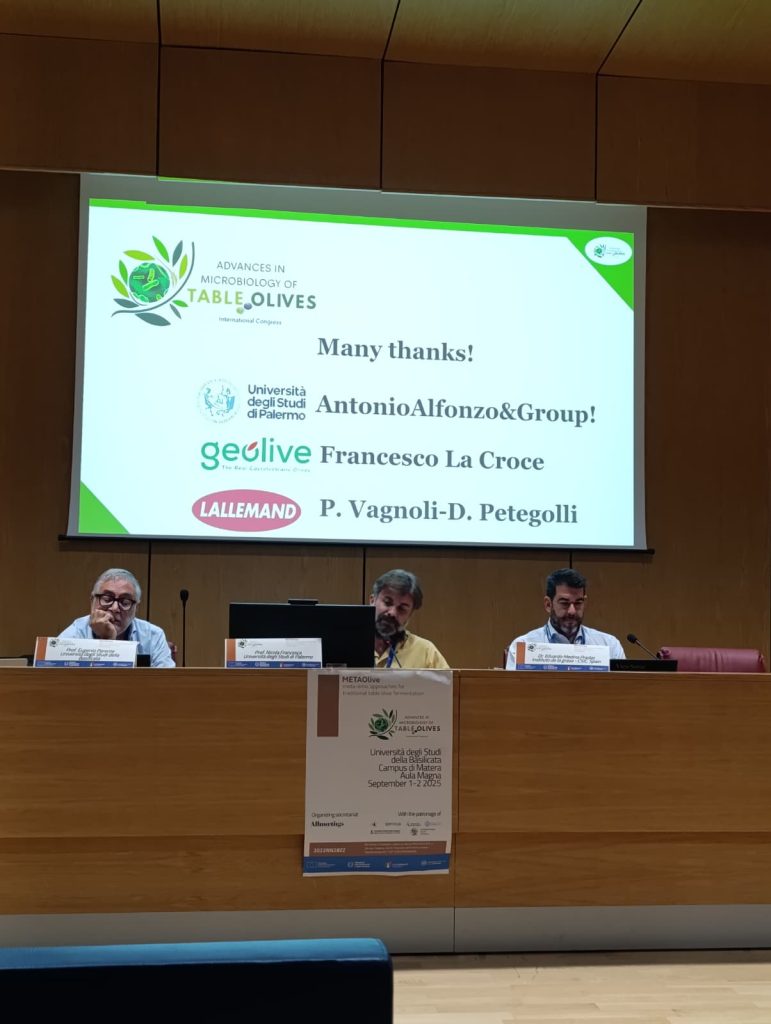
The meeting, held on Monday, September 1st, 2025, took place at the University of Basilicata in the historic city of Matera, Italy. As a UNESCO World Heritage site, Matera offered not only a stunning cityscape but also a vibrant gastronomic scene, making the conference both scientifically enriching and culturally memorable.
Oral Presentation: Microbial Innovation in Table Olive Fermentation
The first work was presented as an oral presentation entitled “Microbial Innovation in Table Olive Fermentation: A Decade of Research on Lactiplantibacillus pentosus OM13.” The study focused on Sicilian table olive cultivars, especially Nocellara del Belice. Moreover, it forms part of a broader scientific effort to better understand and manage microbial communities in fermented vegetables. In particular, the research highlights the role of lactic acid bacteria (LAB) and yeasts in shaping the quality, flavor, and safety of table olives.
Poster Presentation: Bioprotective Co-Inoculation Strategies
The second study, titled “Bioprotective Co-inoculation Strategies for the Optimisation of Nocellara del Belice Table Olive Fermentation,” was presented as a poster. It explored co-inoculation approaches using lactic acid bacteria (LAB) and yeasts, which have shown strong potential to modulate fermentation dynamics and prevent spoilage. In addition, the use of defined starter cultures enhances process reproducibility and ensures compliance with food safety standards.
Poster Presentation: Bioprotection under Different Thermal Conditions
The third study, entitled “Bioprotection of Nocellara del Belice Table Olives: The Effect of Candida boidinii LC1 and Candida norvegica OC10 Under Different Thermal Storage Conditions,” was also presented as a poster. The Castelvetrano method, a traditional Sicilian process for Nocellara del Belice olives, yields products with a distinctive sweet flavor and bright green color, contributing to their strong commercial appeal.
However, high storage temperatures often shorten shelf life due to microbial spoilage, forcing producers to depend on expensive refrigeration. To address this issue, the study evaluated the bioprotective potential of two yeast strains—Candida boidinii LC1 and Candida norvegica OC10—previously selected for their technological and antimicrobial properties.
The results suggest a promising strategy to enhance product stability while reducing energy consumption.